
They splice an LLM into a pipeline and call it an agent
Automation tools like n8n, Zapier, and Make market themselves as AI. But they are not AI. They briefly splice an LLM's output into an otherwise deterministic code flow. Which means they are even further from being AI agents. People love the word agent, so these products wrap themselves in it and sell the wrapping.
A real agent performs a task while expanding it on its own, interpreting the work and improving it as it goes. The automation tools above cannot do this. Not “do not.” Cannot. Their architecture is a chain of deterministic nodes that borrows an LLM for a moment and lets it go.
Think about automating a blog. You research a topic, log in to the site, click write, compose the post, and submit. When a human does this, most of the time goes into choosing the topic, and even after writing, the human reviews and second guesses the draft. An automation tool splits the job like this: deterministic parts such as login and publishing become code or MCP calls, and the parts that need reasoning, research and writing, borrow an LLM. It hands over a fixed prompt, takes whatever comes back, and pastes it in. This works for simple jobs. Bulk daily sends, that kind of thing. But go one level deeper into a loop and problems pour out. These tools are not agents, so they hold no memory. The LLM sitting in each node is a temporary API that gets called once, from scratch, every single time.
The seat was always meant for an agent
So we built Agentlas Graph. No automation tool in existence can replicate it, because this graph treats agents and automation nodes as two different things.
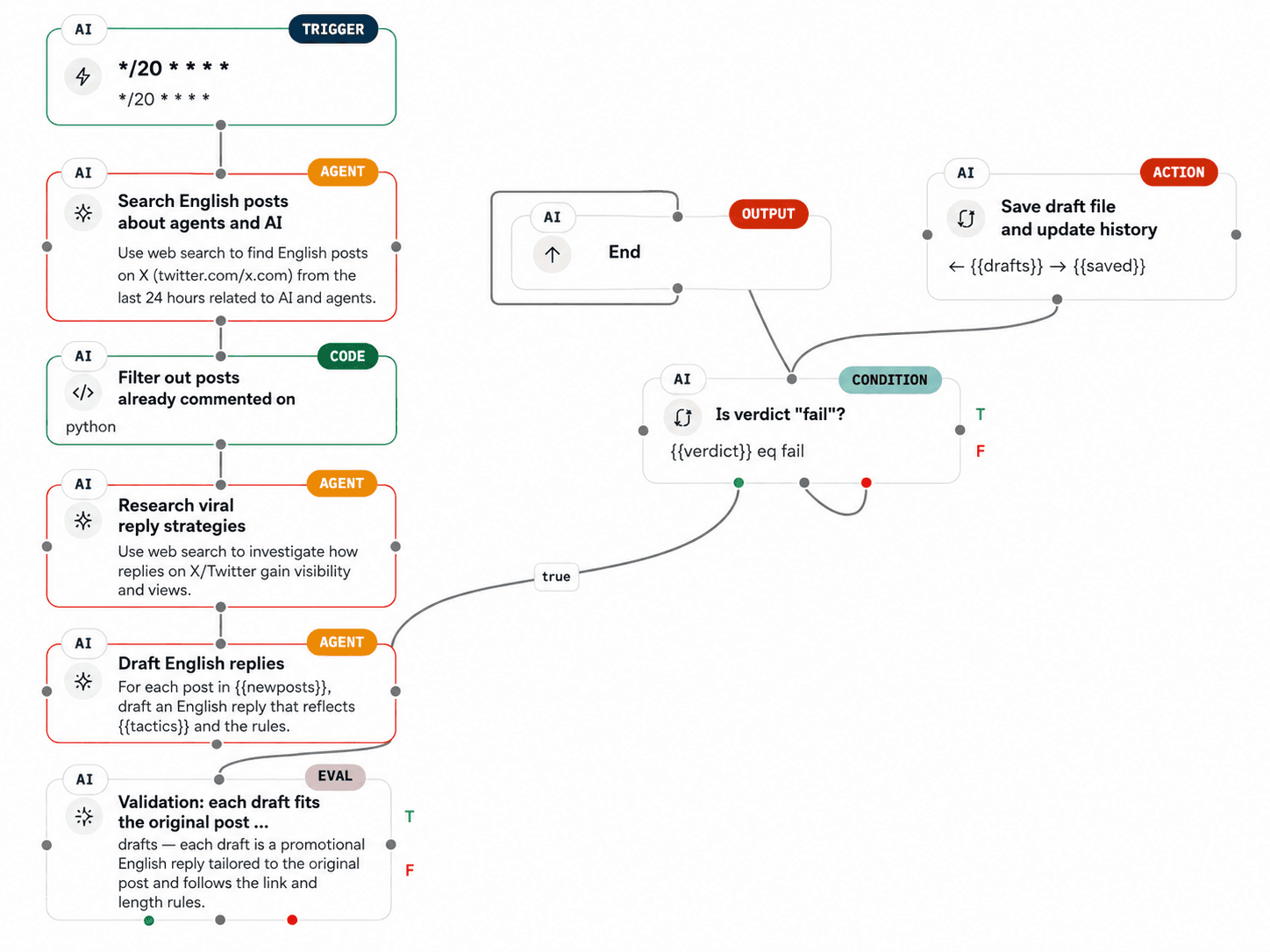
Here is the core of it. The seat where the LLM sat in those tools was always meant for an agent. Automation tools claim that they themselves are the agent, so it never occurs to them to put an agent inside a node. Agentlas Graph defines that seat as an agent slot. You can mount anything into it: an agent from the Hub network, an agent on your machine, an agent in the cloud. You probably will not mount a wargame simulation agent or a drone swarm pilot into a blog research slot. You could. It would be entertaining. Efficiency not guaranteed.
Free, and it runs on your desktop
Two more things need saying. First, they are paid products. The business of n8n, Zapier, and Make is a subscription that meters how many times your automation runs. The better your automation works, the bigger your bill. Agentlas Graph is free. Download the desktop app and the graph is in it, with no metering on runs. Even the model cost rides on runtimes you already use, Claude Code, Codex, or Gemini, and if you attach a local Ollama model, the model cost is zero too.
Second, they run on someone else's servers. Your data, your credentials, and your output all pass through their cloud. Agentlas Graph runs on your desktop. The research, the drafting, the file writes all happen inside your computer. Because it runs locally, it can automate work that touches the files on your machine. A cloud automation tool structurally cannot imitate that.
Side by side
- Footnote: n8n offers a free self hosted edition, if you know how to stand up and operate a server. The person who can do that is not who this essay is for.
| n8n / Zapier / Make | Agentlas Graph | |
|---|---|---|
| Price | Subscription. Runs and seats are metered. Free tiers exist to funnel you into paying | Free. It ships inside the desktop app and never meters your runs |
| Where it runs | Their cloud servers. Your data and credentials pass through someone else's machines | Your desktop. Data, credentials, and output never leave your computer |
| The reasoning step | An LLM node. A fixed prompt fires a disposable API call every time | An agent slot. Mount agents from the Hub network, your machine, or the cloud |
| Memory | None. The LLM in a node meets your work for the first time on every run | Agents are assets, so experience and memory accumulate in the agent |
| Agent identity | None. A model name and a prompt string | Every part is tracked by a unique hash. Versioned, traceable A2A assets |
| How you build | Pick, wire, and configure nodes one by one. Even the AI builders hand the setup back to you as a to do list | Start with one sentence. The AI interviews you and assembles the graph |
| Verification | Bolt it on yourself. The default flow ships without review | A rubric verifier lives inside the graph. Failed drafts get sent back and rewritten |
| Steps that reach outside | Turn it on and it goes | Born locked. Nothing executes until a human approves it |
| Sharing what you built | Templates. The recipient rebuilds credentials and settings from scratch | Packages. One install button. Secrets are stripped automatically at publish |
Why only Agentlas can do this
There is a reason we can do this. From the beginning, Agentlas has treated the agent as an asset: every part carries a unique hash, and agents register on the Hub network where they can be shared. It is the completed form of A2A. Frankly, the A2A 1.0 sitting at the Linux Foundation today is behind what Agentlas already runs. That foundation is what makes it possible to plug an agent into a graph node.
Once the agents are placed, the remaining deterministic nodes go in, and so does a verifier. And the whole process starts from a single sentence: “build me a blog automation.” The AI interviews you and finishes the graph. Years ago I tried to learn an automation tool and gave up because it was too hard. Automation must not remain the property of developers, the way Python is. There is no deep expertise left to require and no technical wall left to climb. It simply responds to your will and your appetite.
Install a giant, or become one
One last piece. Agentlas Graph packages the finished graph itself. Publish it to the Hub network with our A2A technology and that graph becomes a working program in its own right. Anyone who wants to automate a blog installs the graph and presses one button.
In other words, humanity is done climbing onto the shoulders of giants. We are about to learn how to become one.