
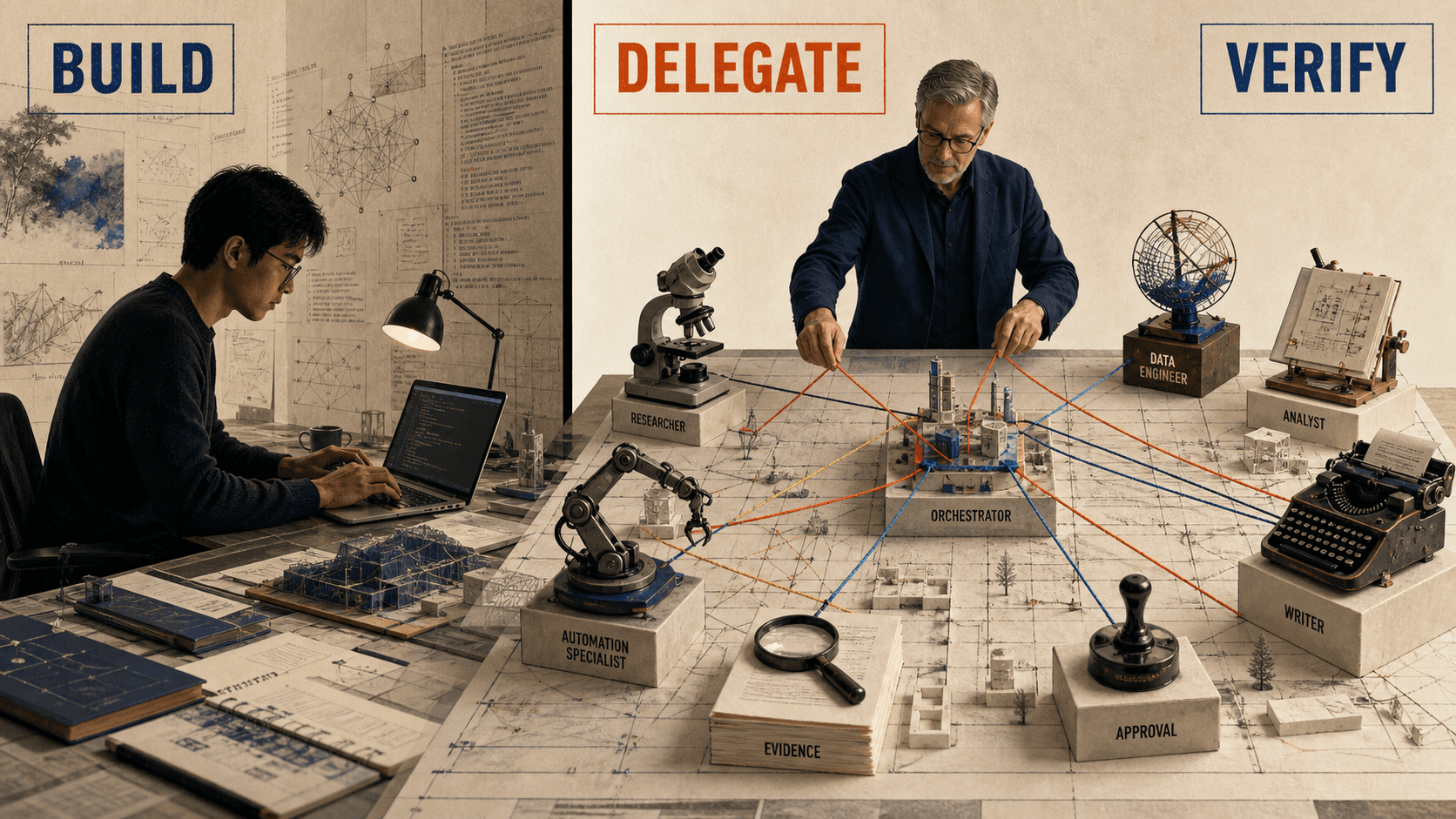
AI talent does not mean “another developer for the AI team”
When a company says it needs AI talent, the job description usually tilts toward engineering: models, data, APIs, and automation. Those skills matter. But the moment several agents begin sharing real work, the scarcer capability appears somewhere else.
Someone has to define the job, decide what one specialist should own and what a team should divide, place the right evidence and tools, draw the authority boundary, design the handoff, and challenge the final answer. That is much closer to senior team management than to model development.
The person who can build an AI organization may be a sales lead, finance controller, production manager, or clinical research director. The decisive skill is being able to decompose a domain into work, roles, evidence, approvals, and review. Code makes that design executable; it does not replace it.
What we mean when we say “agents are 99% HR”
The 99% is not a survey result. It is a deliberate design thesis: stop treating an agent as one model call. Most of the hard, persistent questions are organizational. Who owns which role? What may they read? What must they produce? Where does their authority stop? Who reviews the work?
Agents are not employees. They cannot sign employment contracts or accept human accountability. What can be transferred is the operating grammar of an organization: role requirements, resumes, staffing, reporting lines, handoffs, evidence, and approval. Agentlas borrows that grammar, then turns it into machine-checkable contracts.
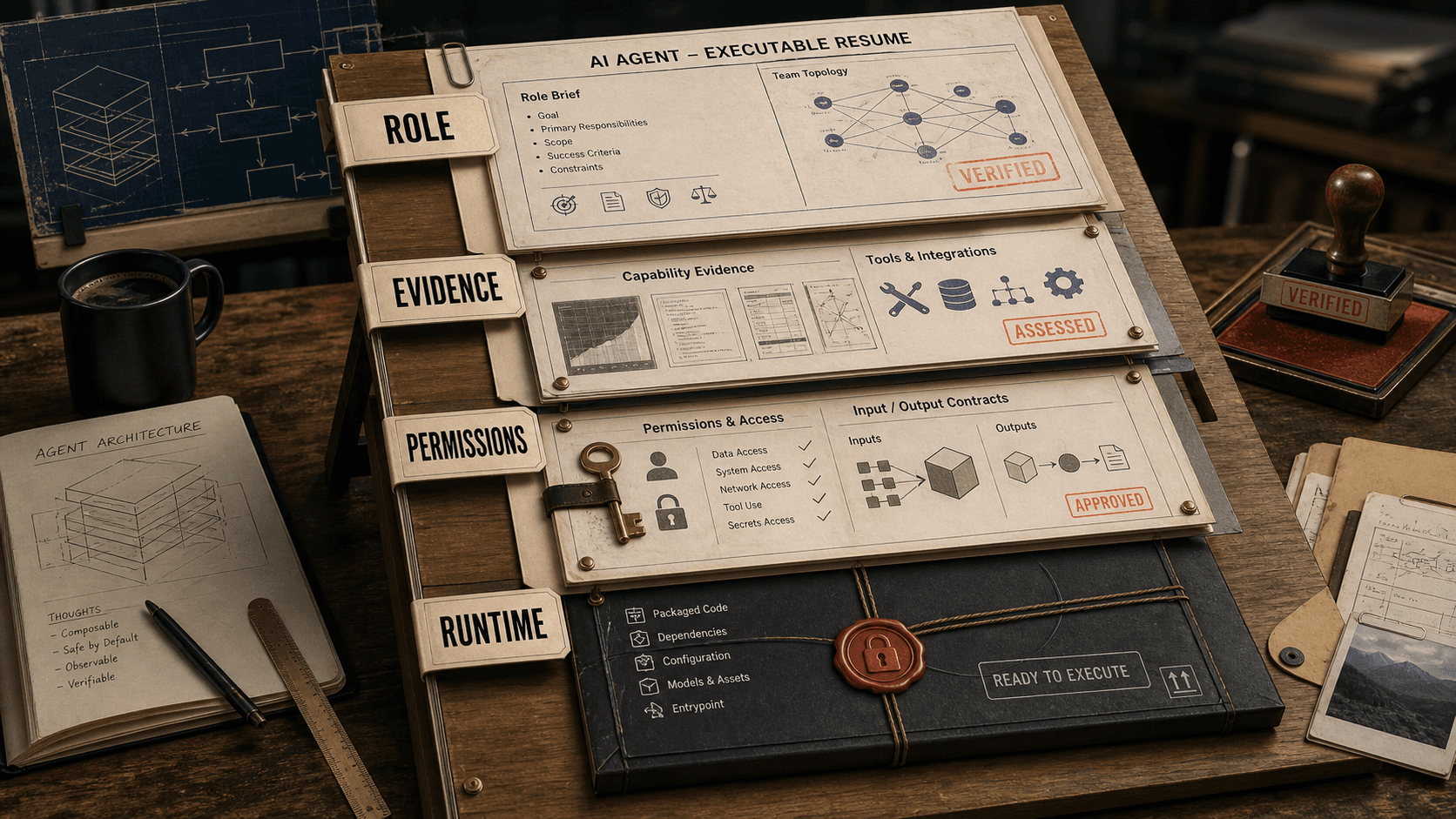
hep-build creates an executable resume, not a personality prompt
The Agentlas builder does not stop at a page of character instructions. It first decides whether the package is one agent or a team of independently accountable roles. It then combines a builder interview, primary-source and comparable-agent research, input and output contracts, tool and permission policies, failure conditions, an evaluation plan, and runtime adapters.
The package includes human-readable operating documents such as agent.md and AGENTS.md, plus machine-readable routing metadata, agentlas.json, MCP policy, team topology, and input-output schemas. The build and upload path compiles .agentlas/brief.json from those materials. The code calls it a compiled resume. It is not filled in by creative guesswork; a missing capability remains a gap.
The WorkforceProfile used by Network structures that resume further: roles, communities, skills, knowledge, tool capabilities, accepted inputs, produced artifacts, authorities, runtimes, languages, modalities, and team pattern. A declared capability is kept separate from one supported by a static check, work sample, or external attestation.
Network receives a WorkOrder, not a prompt-shaped search query
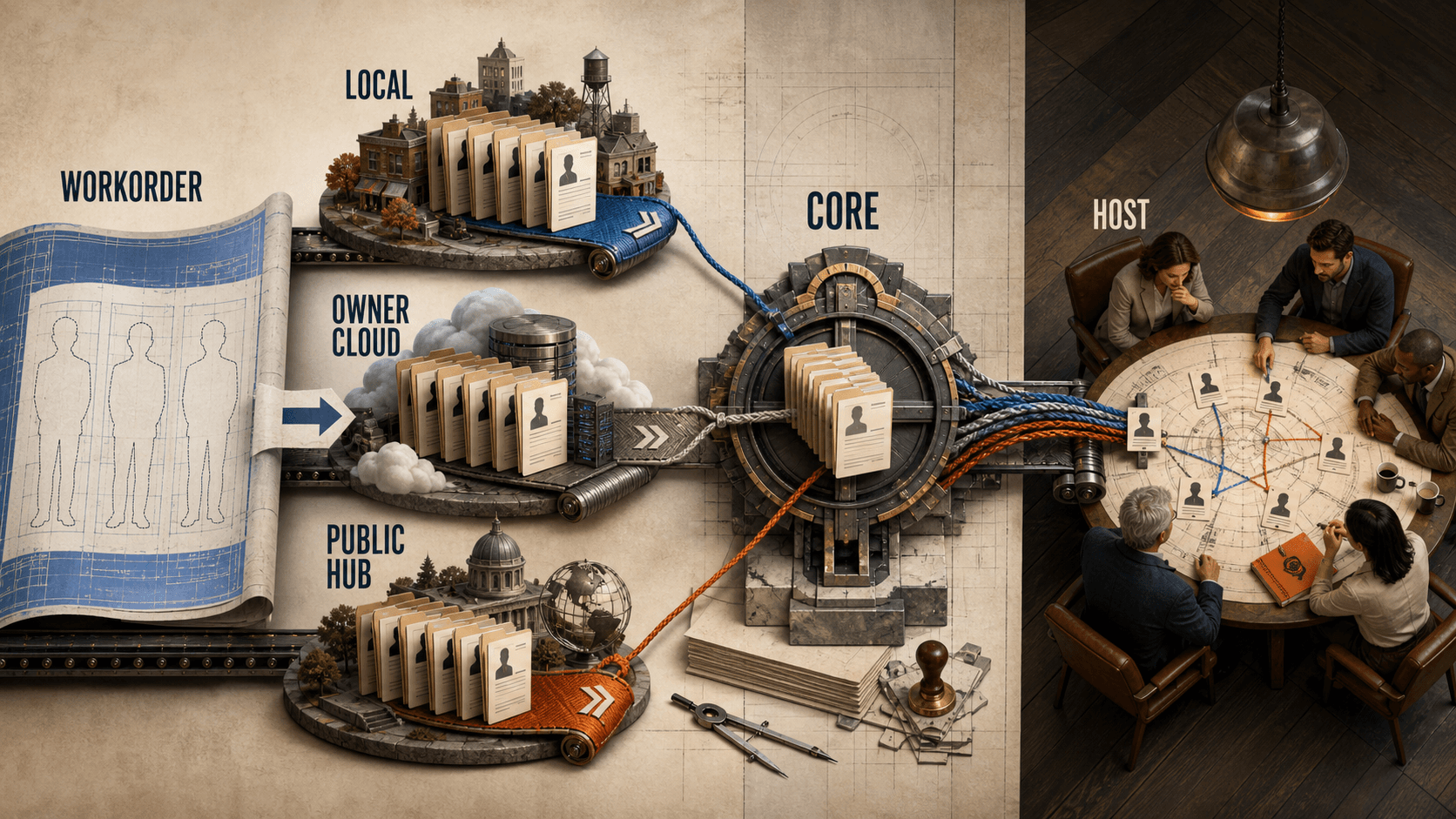
A recruitment brief is a useful metaphor. The actual contract is a WorkOrder. It is not the user's raw prompt copied into a marketplace. It is a redacted description of the open seats required to complete the current job.
The host LLM analyzes the task and creates RoleSlots. Each slot can declare its assignment, required and preferred roles or skills, necessary tools, inputs, outputs, languages and modalities, required and forbidden authorities, headcount, criticality, and reporting, handoff, or review relationships. Private files, account identifiers, secrets, and sensitive project context stay with the host.
That structure requests candidate menus from registered Local inventory, the owner's private Cloud inventory, and the public Hub. Core validates and federates those menus; it does not make the final hire. Installs, ratings, invocation history, revenue, and source priority are not semantic fit. The host LLM reads the candidates and authors the selection for the work at hand.
A resume finds the candidate. An exact release authorizes execution.
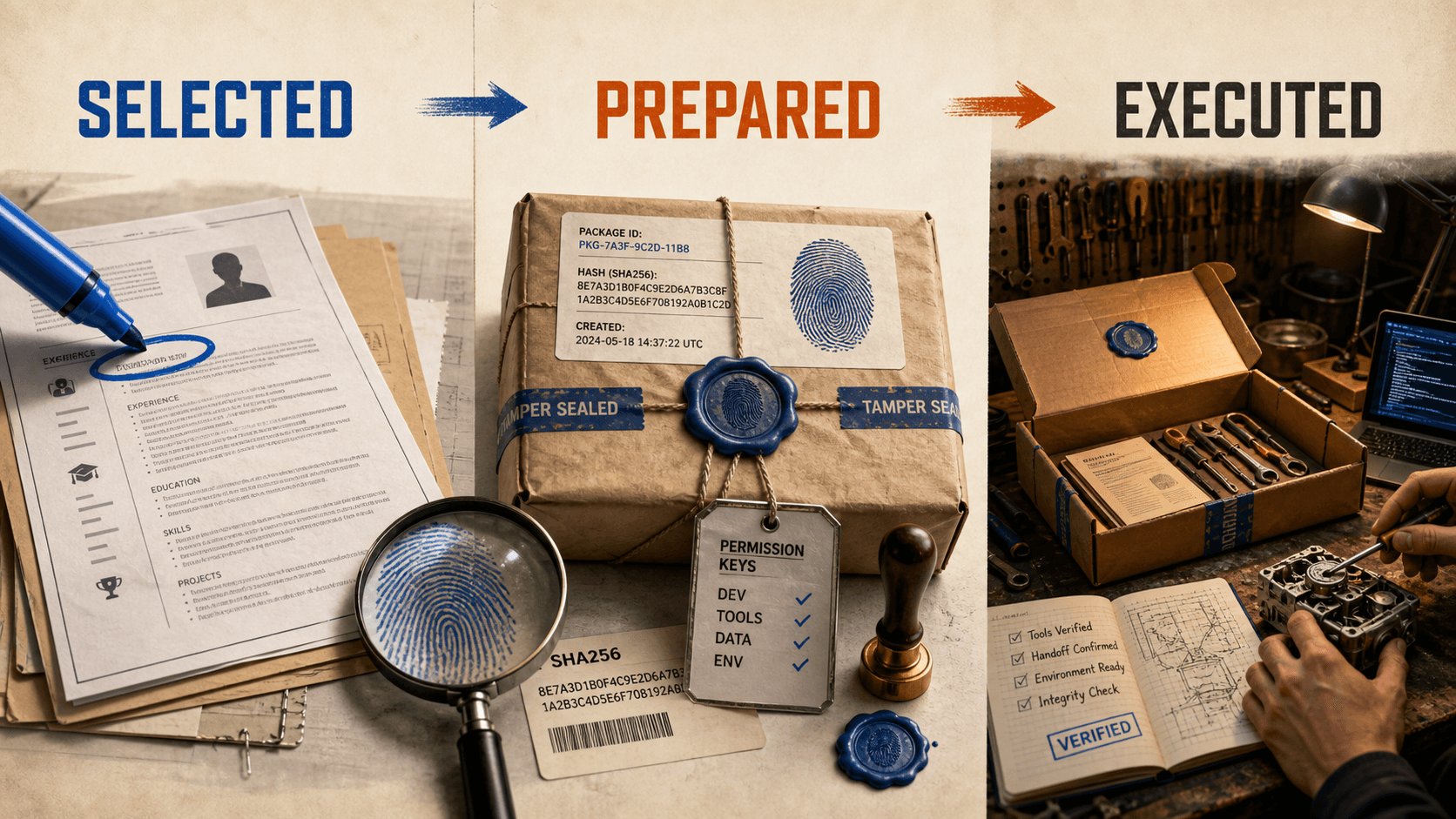
Seeing a name in the candidate menu does not make an agent runnable. Once the host authors a Selection, Core checks that every required slot is filled, every assignee came from the same CandidateSet, the collaboration graph is valid, and the chosen release is the exact one offered in that menu.
Only then can prepare_execution return to each original source session and retrieve the runtime bundle whose package hash and content digest match that release. It does not search again by name or by latest. The bundle must carry executable directives, a permission policy, and—when it is a team—the manager-worker execution graph. Unspecified permission does not inherit the host's authority; it closes to deny-all.
The distinction is operational, not cosmetic. Selected means the resume was chosen. Prepared means the exact executable asset was secured. Executed means the host actually ran the model calls, handoffs, synthesis, and verification. Evidence from one stage is not proof of the next.
The Hub does not run the workforce. The user's runtime does.
Agentlas Hub agents and teams are BYOM bundles. The Hub supplies candidates and executable instructions; it is not a server-side LLM that completes the user's work. The chosen bundle runs inside the current host, grounded in that host's project context, model sessions, files, and tool permissions.
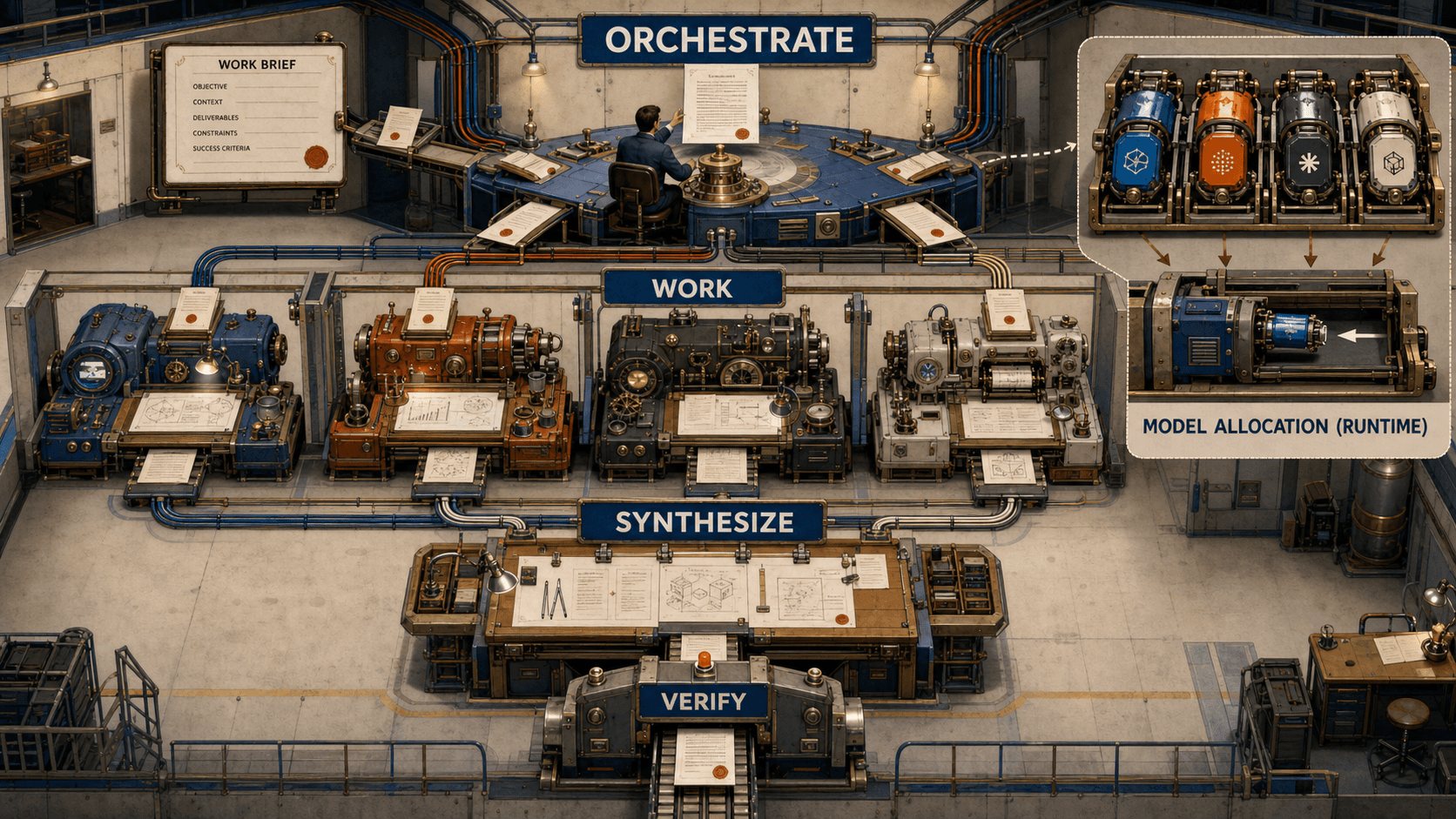
The sequence looks like an organization because it is one. An orchestrator plans and assigns work. Each worker receives a separate call and produces its own artifact. Handoffs complete before synthesis, and an independent verifier checks the requested result. If the package is a team, its manager, worker, and synthesis graph remains intact. One model pretending to be several people inside a single response is not evidence that a team ran.
A good work instruction gives the orchestrator judgment material
Users do not need to pin a model name for every orchestrator and worker. Agentlas separates planning, management, synthesis, and verification into orchestrator stages, while execution and delegated tasks use worker stages. Immediately before a call, the host's live session inventory and operator policy resolve the provider, model, session, and effort.
A task prompt or Hub bundle cannot override operator model pins or cost limits, and Core does not carry a permanent table of vendor model names. Models change; the role contract survives. The actual allocation remains bound to what the host can run at that moment.
So the work instruction should contain judgment material, not model branding: the objective, completion criteria, hard constraints, acceptable evidence, deliverable format, role ownership, handoff order, and verification method. The orchestrator uses that material to design the organization. The runtime assigns suitable models to the resulting stages.
A work instruction worth sending
“Write an English technical feature explaining Agentlas hep-build and Workforce Network for business unit leaders. Challenge the assumption that AI talent is only an engineering hire. State that ‘99% HR’ is a design thesis, not a measured statistic. Use only claims supported by the current code and schemas, and pair every recruitment metaphor with the actual contract name.”
“Split the work into source inspection, editorial writing, and independent verification. The researcher must attach file-level evidence to product claims. The editor must remove generic AI copy. The verifier must reject any sentence that confuses selected, prepared, and executed. Deliver a 12-minute article with visual explanations of the executable resume, the WorkOrder flow, exact-release preparation, and user-owned runtime execution.”
This tells the orchestrator what to optimize. It gives the user more control than “use the best model,” while leaving provider and model allocation where they belong: in live host policy.
The bottleneck is the ability to describe an organization
Model performance will keep changing. Business work still runs on responsibility, authority, evidence, handoffs, approval, and review. If a company understands that structure only as tacit knowledge and cannot express it as an operating contract, its agents will remain demos.
That is why Agentlas builds agents, recruits through Network, and executes inside the user's runtime. The goal is not to summon more AI. It is to create an organization that can explain which work was assigned, which resume and authority justified the choice, which exact release ran, and who verified the result.